
Oplus_131072
KALIMANTAN, bhayaksa.net—-
Special report on the customary laws of the Dayak Ngaju tribe
The Dayak Ngaju people of Central Kalimantan firmly adhere to the life philosophy of “Belom Bahadat”, which translates to living one’s life strictly in accordance with noble customary tatenan (laws). For them, adat is not merely a collection of ceremonial customs, but a moral compass, the foundation of their native Kaharingan religion, and a sacred law that maintains total balance between humans, the universe, and ancestral spirits.
Here is an in-depth report on the existence, origins, formulators, and the complex system of the “Singer” Customary Sanctions that bind the Dayak Ngaju community to this day:
Origins: When Did the Customary Law Begin?
The existence of Dayak Ngaju customary law is divided into two distinct timelines:
- The Mythological Dimension (The Beginning of Creation): According to the native Kaharingan faith, adat (hadat) is sacred because it is believed to have existed since the universe was created. These divine laws were handed down directly by the Almighty God (Ranying Hatalla Langit) when the first humans descended to earth. Therefore, spiritually, it is as old as human existence itself.
- The Historical Dimension (Migration & Consolidation): From a historical and archaeological perspective, the customary structure took deep root when their ancestors migrated to the interior of Borneo thousands of years ago (around the 2nd century BC to the 2nd century AD). This law continued to evolve orally through generations to regulate jungle survival, territorial boundaries, and marriage customs.
Who Formulated the Customary Law?
Dayak Ngaju customary law was not authoritariantly established by a single ruler, but rather through the accumulation of wisdom and consensus:
- Ancestors and the Wisdom of Nature: Initial regulations were shaped by ancestors who interacted directly with nature. They interpreted signs of nature as divine guidance, which was later mutually agreed upon by past tribal chiefs into binding, righteous customs.
- The Tumbang Anoi Grand Council (1894): The key figures who systematically codified Dayak customary law into its modern, structured form were the Dayak tribal chiefs from across the entire island of Borneo during the Tumbang Anoi Grand Council of 1894. This historic assembly successfully ended the intertribal warfare tradition (mengayau) and formalized traditional laws into 96 Articles of Customary Law, which included converting blood feuds into monetary customary fines.
The Intricate Details of “Singer” Customary Sanctions
The Dayak Ngaju customary justice system champions the principles of restorative justice, where the customary fines known as Singer aim to cleanse the village of spiritual misfortune (menyau huma/lewu) and restore the cosmic balance disrupted by a violation. The fine values are measured in a traditional unit called Kati Ramu (originally high-value sacred heirlooms, which have now been converted into standardized monetary values).
The following are the precisely categorized tiers of Singer sanctions:
1. Low-Level Infractions (Social Etiquette & Decency)
- Singer Sala Basa Dengan Oloh Beken: A fine levied for behaving inappropriately, acting rudely, threatening, insulting, or defaming someone, causing them to suffer public humiliation.
- Singer Lungkun Tapang / Uap Huma: A fine for entering someone else’s yard, land, or house without permission, as the Ngaju people strictly respect residential privacy boundaries.
- Singer Tandahan Randah: A fine for making reckless accusations or slanderous claims without valid evidence.
2. Mid-Level Infractions (Property & Ownership)
- Singer Karusak Ramu: Denda imposed when someone destroys another person’s valuable property, whether intentionally or through negligence, carrying the obligation of full compensation.
- Singer Rampas Takau Ramu Luar Huma: A fine for stealing, cheating, or forcibly taking another person’s property located outside the house area.
- Singer Tandahan Ramu: A customary sanction imposed on those proven to be selling, buying, or acting as a fence for stolen goods.
3. High-Level Infractions (Morality, Misconduct & Marriage)
- Singer Tungkun: A severe moral fine imposed on perpetrators of adultery, extramarital affairs, or eloping with someone else’s spouse. The violator must pay dozens of Kati Ramu and bear the living expenses of any abandoned children.
- Singer Tekap Bau Mate & Dusa Sala: A dual sanction applied if a man is caught red-handed inside the bedroom of a woman who is not his wife (habandung). Tekap Bau Mate (meaning “covering the eyes/face”) is paid to the woman’s heirs to erase the family shame, while Dusa Sala is paid to her parents.
- Singer Tandah Hantuen: A massive fine for recklessly accusing someone of being a Hantuen (a mythical, organ-eating creature/kuyang) without concrete proof, as this accusation is viewed as character assassination that ruins the victim’s social life.
4. Extreme Infractions (Life & Cosmic Existence)
- Singer Sahiring: The highest customary sanction, imposed on perpetrators of murder or those who cause the loss of another person’s life. This fine runs concurrently as family restitution alongside state criminal prosecution.
- Singer Banguhan, Penyau, Penyang: An additional fine for homicide cases, allocated specifically to fund sacred purification rituals for the surrounding land and water to cleanse the bloodstains, preventing the village from cosmic curses or natural disasters.
Witness Testimony: Maintaining Harmony in the Modern Era
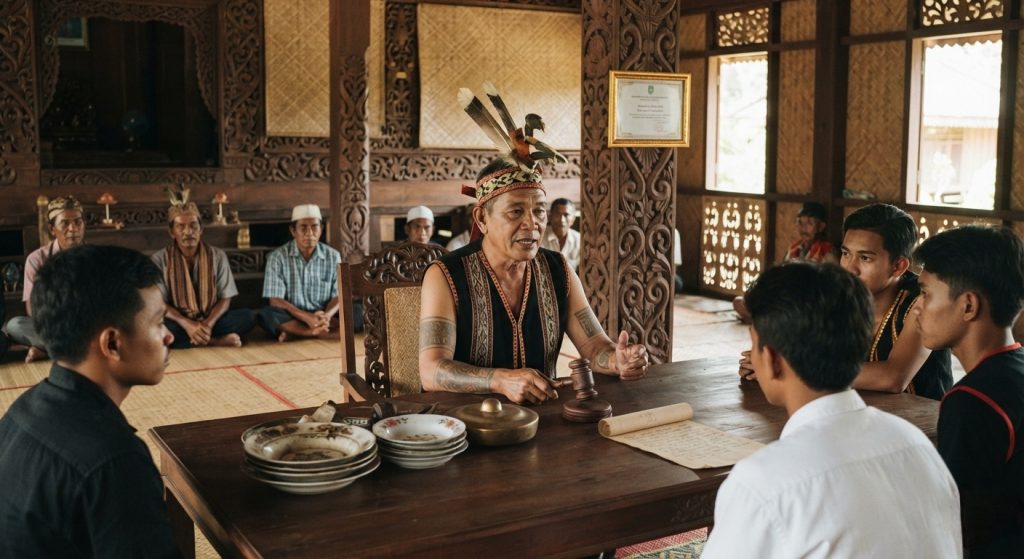
The active enforcement of this customary law was confirmed directly by a prominent Damang (Customary Chief) in the Barito region of Central Kalimantan. In an exclusive interview, he revealed the core philosophy behind the strictness of these customary sanctions.
“Customary law through the Singer system is not our way of making a profit or making people suffer. The soul of Singer is restoration. When someone violates adat, a social and spiritual imbalance occurs in that village. Through customary trials and the payment of fines, we heal broken hearts, cleanse our homeland of spiritual pollution, and reunite severed brotherhood. That is where true justice lies,” the Damang stated with immense dignity.
He further noted that the biggest challenge in today’s digital era is ensuring that the younger generation remains grounded in their true identity.
“The world may advance, and technology may grow exponentially. But for the descendants of the Dayak Ngaju, the principle of ‘Belom Bahadat’ must never fade. Living without customs and ethics is like a tree without roots—it easily topples in the storms of time,” he concluded firmly.
Does It Still Exist Today?
Yes, Dayak Ngaju customary law remains very much alive, active, and powerfully binding today. Their customary institutions are formally integrated into the local governance structure in Central Kalimantan through Damang Kepala Adat (at the township level) and Mantir Adat (at the village level).
In modern life, Ngaju customary law coexists harmoniously alongside Indonesian state law in several crucial areas:
- Marriage Law: Every marriage within the Dayak Ngaju community must undergo customary rituals (such as fulfilling the Petak Palaku customary dowry and Jalan Hadat requirements) witnessed directly by a Mantir or Damang, even if the couple is already legally married by their religion and Civil Registry.
- Dispute Resolution: Disputes over customary lands, territorial boundaries, moral violations, and communal conflicts are still frequently resolved in the Damang’s office. Local police departments routinely prioritize customary law mediation to preserve peace and social harmony in the lands of Kalimantan.
Reporter: Mustalim
Editor: bhayaksa.net 𝗧𝗲𝗮𝗺