
AUSTRALIA, bhayaksa.net—- In an era of aggressive digital banking expansion, Automated Teller Machines (ATMs) remain the absolute backbone of global physical liquidity. However, behind the seamless transaction that takes seconds for the end-user, lies a highly complex infrastructure of global networks and mechanical precision hidden from the public eye.
In an official confirmation received by bhayaksa.net reporters on Wednesday, September 16, 2026, Paul Gardiner, an Australian technology expert and global payment systems specialist, dissected the internal architecture driving ATM operations. Gardiner explained that while the consumer experience is remarkably straightforward—inserting a card, entering a PIN, and collecting cash—the backend data pipelines and network logic operate with staggering complexity.
From a business standpoint, Gardiner highlighted the critical challenge banks face in managing idle cash costs. Cash sitting inside an ATM is a financial liability because it yields no interest. Consequently, financial institutions rely on predictive algorithms to balance service optimization; minimizing idle cash reserves while ensuring constant availability to preserve customer retention. This independent network ecosystem is funded through domestic interchange fees and consumer surcharges. Furthermore, current global trends show a major shift toward outsourcing ATM operations to third-party networks, allowing banks to cut operational overhead and pivot resources toward digital banking infrastructure.
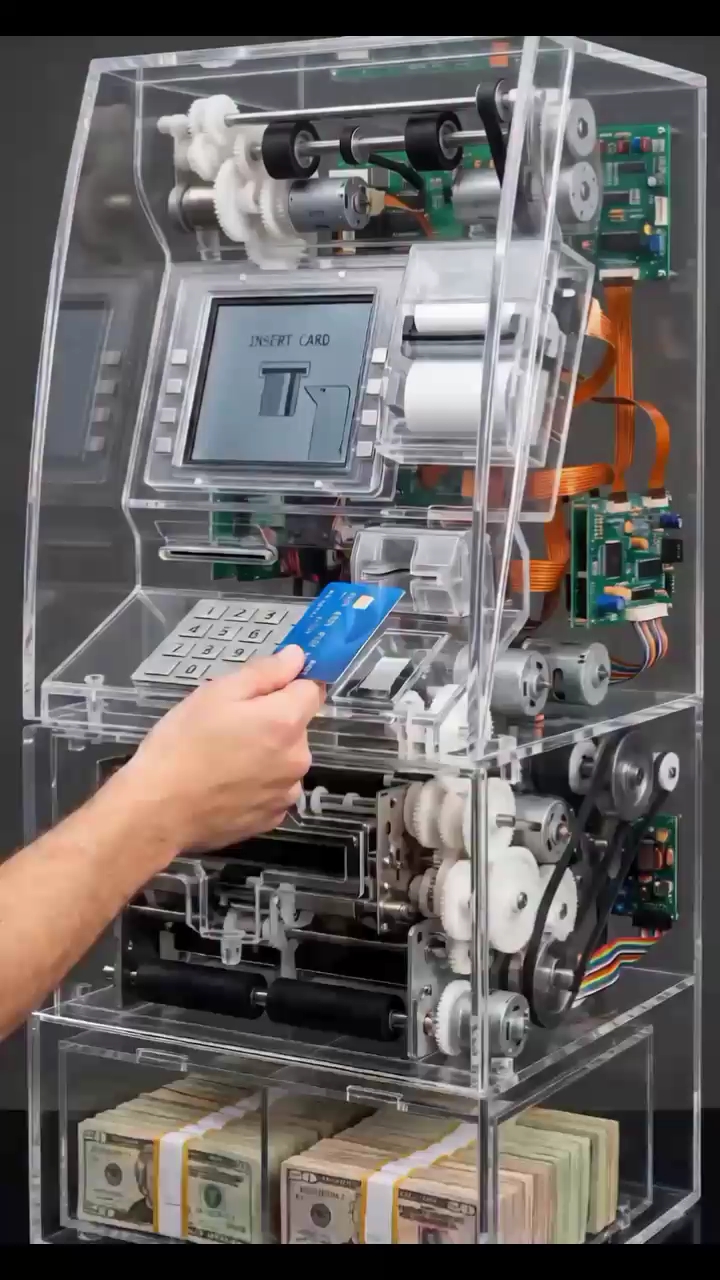
Behind the financial management, the physical machinery of an ATM functions as a high-precision robotic computer. Based on an educational clear-casing model, the ATM ecosystem is divided into three core compartments. The top section houses the Input Processing Unit, featuring an electronic card reader, a printed circuit board (PCB), an Encrypting PIN Pad (EPP) to secure user inputs, and a receipt printer. The middle section serves as the Mechanical Dispenser Heart, combining a complex array of gears, drive motors, and rubber belts that activate friction rollers to pull banknotes sheet by sheet with micrometer accuracy, preventing jams or double bills. The lowest compartment holds the secure Cash Cassettes inside a reinforced steel vault, protecting the currency before it is rolled up to the delivery slot.
One of the greatest operational hurdles in dispenser mechanics is the risk of double-feeding bills due to static electricity or humidity. To counteract this, modern ATMs are armed with advanced Double-Feed Detection technology. The machinery utilizes Optical Sensors (Infrared Light) to scan bill opacity. If two banknotes stick together, the light transmission drops drastically, triggering an immediate system response. Other machines deploy high-resolution Mechanical Caliper Rollers that detect physical thickness spikes exceeding the standard 0.1 mm threshold, or Ultrasonic Sensors that capture tiny air gaps trapped between overlapping sheets.
When a double-feed is detected, the ATM’s internal computer instantly fires a mechanical divert gate. This gate reroutes the compromised bills away from the consumer and into an internal Reject Bin. The dispenser then immediately draws a fresh note from the cash cassette, ensuring the user receives the exact requested amount without delaying the transaction.
This entire mechanical ballet is governed by data communications spanning thousands of miles within milliseconds. The moment a user submits a command, the PIN is immediately encrypted at the hardware level on the EPP using advanced 3DES or AES algorithms. This encrypted financial message, formatted under the global standard ISO 8583 protocol, is transmitted through a secured Virtual Private Network (VPN) to the banking interconnection core (Switching Network). Within two to four seconds, the network routes the payload to the issuing bank’s Core Banking System for balance and PIN verification, transmits back an Approval Code, and instructs the local dispenser to release the cash. This synergy between global cyber-transmission and localized mechanical reliability makes the ATM one of the most resilient fintech innovations in modern financial history.
Reporter: Mr. David Gunawan Sanjaya
Editor: The bhayaksa.net Team