
Oplus_131072
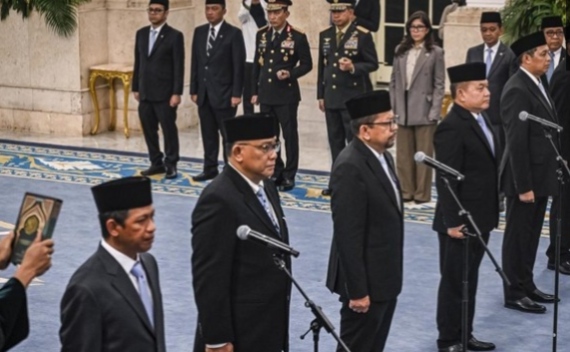
JAKARTA, bhayaksa.net—- A massive wave of evaluation has swept through the national government as the Red and White Cabinet approaches its two-year mark. President Prabowo Subianto officially executed a major reshuffle—marking the 7th cabinet shake-up—I while simultaneously inaugurating a new lineup of coordinating ministers, ministers, deputy ministers, and agency heads at the State Palace, Jakarta, on Thursday, October 1, 2026.
This strategic move is enacted under Presidential Decree No. 104/P of 2026 concerning the Dismissal and Appointment of State Ministers and Deputy Ministers, alongside Presidential Decree No. 105/P of 2026 regarding the replacement of officials at the institutional head level. The extensive restructuring, which includes the creation of new ministerial portfolios, aims to boost bureaucratic efficiency, respond to global geopolitical dynamics, and accelerate the administration’s “Asta Cita” priority programs.
“In the name of God, I solemnly swear that I will be faithful to the 1945 Constitution of the Republic of Indonesia and will execute all laws and regulations as strictly as possible,” President Prabowo declared, followed solemnly by the newly appointed officials during the swearing-in ceremony.
Shifting Coordinating Roles and Diplomatic Reinforcement
A profound shift occurred at the coordinating minister level. Bahlil Lahadalia has been entrusted with a newly tailored portfolio as the Coordinating Minister for Energy and Downstream Affairs, while concurrently holding his definitive post as the Minister of Energy and Mineral Resources (ESDM) to speed up national energy independence. Meanwhile, Sugiono officially vacated his foreign affairs portfolio to transition into the Coordinating Minister for Human Development and Cultural Affairs (PMK), succeeding Pratikno.
The vacant seat of the Minister of Foreign Affairs left by Sugiono is now entrusted to a seasoned career diplomat, Arrmanatha Christiawan Nasir, who previously served as the Permanent Representative of Indonesia to the United Nations. Analysts view Arrmanatha’s appointment as a strong signal that Indonesia intends to fortify its foreign policy stability and secure its bid for a non-permanent seat on the UN Security Council for the 2029–2030 term. Additionally, former Armed Forces (TNI) Commander Dudung Abdurachman, who previously served as the Chief of Presidential Staff (KSP), has been elevated to lead the Coordinating Ministry for Political and Security Affairs (Menko Polkam).
Rapid Succession in the National Police Corps
Beyond the ministerial structure, the leadership succession within the Indonesian National Police (Polri) took center stage. President Prabowo officially inaugurated the former Head of the National Narcotics Agency (BNN), Police General Suyudi Ario Seto, as the new Chief of National Police (Kapolri), replacing Police General Listyo Sigit Prabowo. The top-level transition within the Bhayangkara corps was finalized following a swift review and unanimous confirmation during a Plenary Session at the House of Representatives (DPR RI).
Following the inauguration, General Suyudi affirmed his immediate commitment to internal consolidation to ensure public safety and stability. “We will prioritize enhancing public services, enforcing the law fairly, and bringing the police force much closer to the community,” Suyudi told journalists at the State Palace complex. Meanwhile, former Police Chief Listyo Sigit remains within the inner circle of government; he has been officially reassigned to strengthen the palace defense as the new Chief of Presidential Staff (KSP).
The comprehensive inauguration ceremony concluded with congratulatory wishes initiated by President Prabowo Subianto alongside Vice President Gibran Rakabuming Raka, witnessed by the heads of state institutions and high-ranking officials from the military and police.
Pewarta: Timothy
Editor: bhayaksa.net Team