
Oplus_131072
JAKARTA, bhayaksa.net— The threat of heart disease and stroke now looms over everyone, regardless of age. However, amid the high cost of medical treatment and modern fitness facilities, the public actually has an affordable, budget-friendly exercise option that is highly effective in preventing these two deadly diseases.
To thoroughly uncover the secret behind this physical activity, bhayaksa.net reporter Timothy had the opportunity to interview dr. Vito A. Damay, Sp.JP(K), M.Kes, FIHA, FAsCC, a leading heart and vascular health expert based in Jakarta.
Here is the complete interview transcript regarding the program guidelines and tips for maintaining heart health without a large budget.
Bhayaksa: Good morning, Doctor Vito. Many people complain about how expensive it is to exercise for health. Is it true that there is an affordable exercise that is highly effective in preventing heart disease and stroke?
dr. Vito: “Good morning. That is absolutely correct. The best exercise that is budget-friendly, equipment-free, and can be done by anyone is brisk walking. Many people underestimate walking, even though health experts worldwide, including the WHO and AHA, place this simple aerobic activity as one of the primary weapons for cardiovascular prevention.”
Bhayaksa: How does this brisk walking mechanism protect our bodies from heart disease and stroke, Doc?
dr. Vito: “Brisk walking provides comprehensive protection. First, this activity trains the efficiency of the heart muscle so it can pump blood with lower pressure. This automatically reduces the risk of hypertension, which is the leading trigger for strokes.
Second, brisk walking helps burn bad cholesterol (LDL) and increases good cholesterol (HDL), which prevents arterial clogging. In addition, insulin sensitivity will improve so that blood sugar is better controlled, and blood vessels become more elastic due to the release of nitric oxide. Blood flow to the brain and heart remains perfectly smooth.”
Bhayaksa: For beginners who want to start, what is the ideal dosage or duration to get optimal benefits?
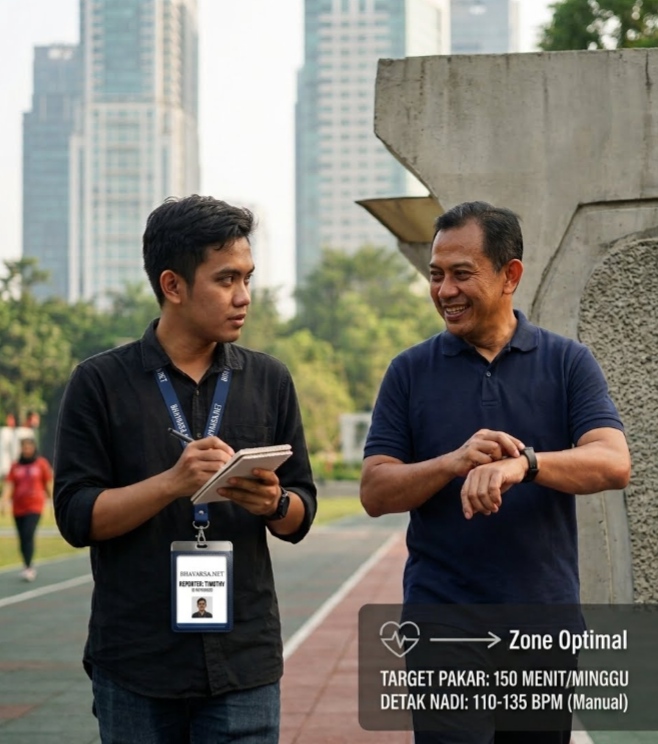
dr. Vito: “The target from health experts is 150 minutes per week. For beginners, do not push too hard right away. I recommend a gradual 4-week program to build up the body’s consistency first. Every session must begin with a 5-minute warm-up walk and end with a 5-minute cool-down.”
Here is the 4-week training program that I recommend for beginners:
- Week 1: 15 minutes of brisk walking (Days 1, 3, 5) 𝗮𝗻𝗱 10 minutes of casual walking (Days 2 𝗮𝗻𝗱 4). Days 6 𝗮𝗻𝗱 7 are rest days.
- Week 2: 20 minutes of brisk walking (Days 1, 3, 5) 𝗮𝗻𝗱 15 minutes of casual walking (Days 2 𝗮𝗻𝗱 4). Days 6 𝗮𝗻𝗱 7 are rest days.
- Week 3: 25 minutes of brisk walking (Days 1, 3, 5) 𝗮𝗻𝗱 15 minutes of casual walking (Days 2 𝗮𝗻𝗱 4). Days 6 𝗮𝗻𝗱 7 are rest days.
- Week 4: 30 minutes of brisk walking (Days 1, 3, 5) 𝗮𝗻𝗱 20 minutes of casual walking (Days 2 𝗮𝗻𝗱 4). Days 6 𝗮𝗻𝗱 7 are rest days.
Bhayaksa: While exercising, how can we know that our walking intensity is optimal and safe for the heart, especially for those who do not own an expensive smartwatch?
dr. Vito: “That is a great question. You do not need an expensive smartwatch at all. There are two manual methods that are very accurate which we always recommend:
- The Talk Test Method: While walking fast, make sure you can still speak in full sentences, but can no longer sing because your breath is shorter. If you can still sing, it means your walk is too slow. If saying even one word leaves you gasping for breath, it means it is too fast; slow down your pace immediately.
- Manual Pulse Count Method: Find your pulse point on the inside of your wrist or neck. Count the number of beats for exactly 10 seconds using a stopwatch on your phone, then multiply the result by 6. For beginners, a range of 110–135 BPM (beats per minute) is a safe and most optimal zone.”
Bhayaksa: Lastly Doc, what about people who have a history of joint pain, such as in the knees or ankles? Is it still safe?
dr. Vito: “It remains safe, as long as three precautions are taken. First, use shoes with soft cushioning to absorb the impact. Second, choose a flat location that absorbs shock, such as a tartan running track or flat grass; avoid hard asphalt. Third, keep your stride length short but consistently fast to reduce excessive pressure on the knee joints. Do not hesitate to consult a doctor if the pain persists.”
About the Expert:
dr. Vito A. Damay, Sp.JP(K), M.Kes, FIHA, FAsCC is a Specialist in Heart and Vascular Diseases as well as a Consultant in Interventional Cardiology who actively practices at various leading hospitals in Jakarta. He is publicly known as a vocal health educator across national media and social media platforms, focusing on preventive healthy lifestyle campaigns to prevent cardiovascular diseases in Indonesia.
Reporter: Timothy
Editor: bhayaksa.net 𝗧𝗲𝗮𝗺