
Oplus_131072
JAMBI, bhayaksa.net—- The enforcement efficiency of the Jambi Customs and Excise Office (KPPBC TMP B Jambi) has come under heavy public scrutiny following a massive surge of illicit Excisable Tobacco Products (BKC HT) across Jambi Province. Weak field surveillance and inspection gaps allegedly serve as the primary catalyst allowing over a dozen unstamped (plain) and tax-manipulated cigarette brands—including Luffman, Manchester, YS Bold, Gocap, Suryaku, BOSS, International Emperor IG, DIZA Click, and SLAVA—to infiltrate domestic supply chains seamlessly. This systemic security breach has triggered urgent demands for an institutional audit of Jambi Customs’ Enforcement and Investigation (P2) unit to secure national fiscal revenue and safeguard corporate compliance.
According to fiscal impact assessments, the estimated distribution volume of these illicit brands throughout the Jambi region has reached 2,500,000 sticks per month. Calculated against the 2026 Tobacco Excise (CHT) statutory rates for Machine-Made Clove Cigarettes (SKM) averaging IDR 1,200 per stick and Machine-Made White Cigarettes (SPM) at IDR 1,350 per stick, the state incurs a direct CHT financial loss of IDR 3,125,000,000 monthly.
This calculation excludes auxiliary revenue instruments, namely the Tobacco Value Added Tax (PPN HT) pegged at 9.9% of the Retail Selling Price (HJE) and the regional Cigarette Tax mandated at 10% of the excise value. Following a consolidated fiscal audit, the cumulative potential loss in state revenue on the national treasury within Jambi Province totals IDR 4,150,000,000 (Four Billion One Hundred Fifty Million Rupiah) per month. This substantial fiscal deviation directly reduces the allocation of Tobacco Excise Revenue Sharing Funds (DBH CHT) originally designated to finance regional healthcare infrastructure.
Legal Jurisprudence and Anatomical Profiling of Seized Physical Evidence
Forensic authentication of security print specifications and packaging design categorizes the syndicate’s operational methods into two primary statutory offenses:
1. Statutory Violation of Tobacco Distribution Without Excise Stamps (Plain Cigarettes)
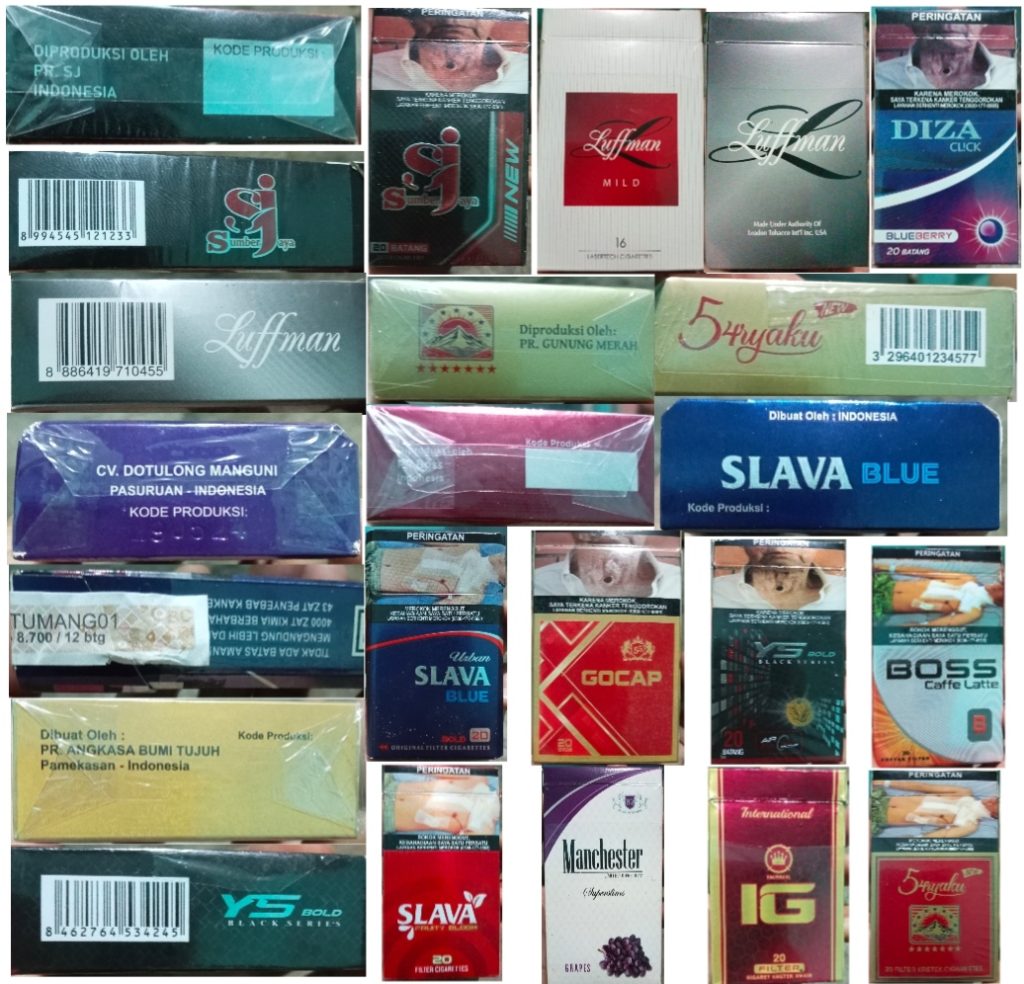
- Luffman Classics (Red & White Variants): Classified as SPM (20-stick pack). The outer packaging bears a corporate claim of Made Under Authority of Leadon Tobacco Int’l Inc. USA. In reality, this commodity constitutes contraband allegedly smuggled through remote coastal entry points (unauthorized seaports) on Sumatra’s east coast, bypassing statutory customs declarations and border control tariffs.
- Luffman Mild (White – Red Box Packaging): A 16-stick format bearing the manufacturing imprint of Lasertech Cigarettes, targeting the domestic low-tar consumer demographic.
- Manchester United Kingdom (Superslims Grapes & Full Purple Variants): An SPM profile (20-stick pack) embedded with international barcode 6291106140538 under the corporate license of J.S.S. Tobacco Ltd. London – United Kingdom. The Superslims Grapes variant is confirmed to integrate synthetic chemical flavoring agents without regulatory permits.
- GOCAP 20 SKM: An SKM profile (20-stick pack) carrying international barcode 8954875334956, explicitly listing the manufacturing entity as PR. ANGKASA BUMI TUJUH (Pamekasan, Madura).
- SURYAKU NEW: An SKM profile (20-stick pack) utilizing barcode 3296401234577, produced by PR. GUNUNG MERAH.
- YS BOLD BLACK SERIES (Maroon & Black Variants): An SKM profile (20-stick pack) affiliated with the unregistered entity CV. INDONESIA TERANG.
- BOSS Caffe Latte: An SKM profile (20-stick pack) under the corporate imprint of PR. Boss – Indonesia.
- SJ Sumber Jaya: An SKM profile (20-stick pack) manufactured by PR. SJ – Indonesia.
- CV. Dotulong Manguni: An SKM profile (20-stick pack) originating from Pasuruan, East Java.
- SLAVA Fruity Bloom: An SKM profile (20-stick pack) claiming lab metrics of 11 Mg Tar and 1.1 Mg Nicotine.
- Legal Assessment: The aforementioned entities were distributed without mandated fiscal stamp affixation, constituting a material violation of Article 54 of Law Number 39 Year 2007 concerning Excise.
2. Statutory Violation of Excise Stamp Misallocation and Fraudulent Classification
- Urban SLAVA BLUE (Blue – Red Packaging): Physical reverse-engineering reveals this packaging falls under the 20 SKM automatic machine-rolled category. However, the package is fraudulently affixed with an official SKT (Hand-Rolled Clove Cigarette) excise stamp designed for a 12-stick capacity, utilizing corporate purchaser identification codes “TUMANG01” or “BERCAHSE00”.
- DIZA Click Blueberry: An SKM profile (20-stick pack) integrating a capsule flavoring mechanism, improperly affixed with a low-tier SKT 12-stick excise stamp under purchaser code “TUMANG01”.
- Legal Assessment: Affixing lower-tier SKT stamps onto high-volume machine-made SKM packs represents corporate tax evasion, fulfilling the elements of tax fraud under Article 58 of Law Number 39 Year 2007 concerning Excise.
Long-Term Clinical Risks Due to Absence of Certified Laboratory Validation
The most critical dimension of this illicit trade is the immediate threat to public health resulting from a total disregard for national industrial tobacco regulations. These unauthorized commodities entirely bypass technical verification by the Ministry of Industry and product safety standards enforced by the National Agency of Drug and Food Control (BPOM).
Chemical profiling and laboratory analysis allegedly indicate that the core tobacco filler consists of low-grade, rejected crop sweepings mixed with substandard cloves. To mask the resulting bitter flavor profile, manufacturers apply unverified synthetic chemical flavoring agents (latte, grape, and blueberry esences) that have not undergone clinical trials. Furthermore, the wrapping paper (papir) and cellulose acetate filters fail to comply with SNI Mandatory Cigarette Component Standards (Ministry of Industry Regulation No. 63 Year 2024).
Due to the absolute absence of certified laboratory testing by the National Accreditation Committee (KAN), the delivery metrics for highly toxic emissions—specifically Tar, Nicotine, and Carbon Monoxide (CO) gas—are unstable and vastly exceed safe thresholds. Consuming these unauthorized products over an extended period is clinically proven to cause severe long-term health degradation for the local population. The bioaccumulation of unverified chemical compounds poses extreme risks of chronic toxicity, accelerating irreversible pulmonary damage (lung cancer), ischemic heart disease, chronic obstructive pulmonary disease (COPD), and systemic organ failure driven by uncontrolled carcinogens.
Logistics Mapping and Cross-Institutional Protection Networks
The illicit distribution infrastructure in Jambi Province operates via segmented terrestrial and maritime logistics corridors:
- Maritime Corridor: Import brands such as Luffman and Manchester are transferred via high-speed craft (ship-to-ship) in international waters before being offloaded at unmonitored local piers along the coastlines of Tanjung Jabung Barat and Tanjung Jabung Timur regencies.
- Terrestrial Corridor: Domestic brands from the Madura and Pasuruan manufacturing hubs are transported via inter-provincial highway networks, concealed beneath legal food supply freights (commodities and groceries).
To evade interception by Jambi Customs’ P2 units, transit points are positioned within peripheral warehouse districts such as Muarojambi, Sarolangun, and Merangin. The goods are subsequently funneled to neighborhood retail stalls and remote kiosks near oil palm plantations or coal mining zones to target low-income laborers.
According to intelligence briefings, the resilience of this logistics chain allegedly relies on covert protection networks and technical assistance (support) provided by corrupt actors embedded within official regulatory and enforcement institutions. The flow of illicit coordination funds to protect transit routes and distribution vans allegedly traces back to influential figures operating under the initials A, T, K, H, J, B and I. These cross-institutional actors allegedly act as territorial coordinators to suppress legal intervention and shield the syndicate from criminal prosecution
Material Criminal Penalties and Judicial Consequences
Under statutory criminal jurisprudence, the physical evidence documented within Jambi territory satisfies the elements for immediate judicial prosecution and strict asset forfeiture:
- Criminal Penalties Under Article 54 of the Excise Law: Parties distributing unstamped plain cigarettes face a mandatory minimum prison sentence of 1 year up to a maximum of 5 years, alongside financial penalties ranging from 2 to 10 times the value of the evaded excise tax.
- Criminal Penalties Under Article 58 of the Excise Law: Parties engaged in excise classification fraud (e.g., Slava Blue and DIZA Click) face 1 to 5 years of imprisonment, plus restitution mandates to cover all state revenue deficits.
- Absolute Asset Forfeiture (Article 62 of the Excise Law): All seized illicit products and the transport vehicles utilized in these offenses are classified as State-Owned Property (BMN) and are subject to immediate destruction.
The Ministry of Finance maintains a zero-tolerance policy against tax fraud and corporate evasion. A rigorous, comprehensive crackdown by joint task forces in Jambi Province is vital to dismantle this entire illicit enterprise, including the immediate prosecution of the institutional protectors operating under the initials A, T, K, H, J, and I, to restore fiscal stability, protect public health, and uphold national rule of law.
Reporter: Harvery.
Editor: Tim bhayaksa.net