
Oplus_131072
MUARA SABAK, 𝗯𝗵𝗮𝘆𝗮𝗸𝘀𝗮.𝗻𝗲𝘁– The implementation of the $170,000 (Rp2.74 billion) free school uniform social assistance program in Tanjung Jabung Timur Regency (Tanjab Timur) for the 2025/2026 fiscal year has come under heavy public scrutiny. Public concern escalated significantly following the sudden, unilateral cancellation of a planned mass protest by the Indonesian Cyber Journalists Alliance (AWaSI) Jambi in front of the Regent’s Office on Thursday, September 10, 2026. The abrupt cancellation without any official explanation has raised serious public concerns regarding the transparency of the ongoing investigation into alleged procurement irregularities.
The Root Cause: Illicit Multi-Tiered Subcontracting Chain
According to the official 2026 Audit Report (LHP) issued by the Audit Board of Indonesia (BPK RI) Jambi Representative, the flagship program intended to supply 9,974 sets of uniforms for newly enrolled students across preschools (PAUD/TK/RA), elementary schools (SD/MI), and junior high schools (SMP/MTs) was distributed through three e-Catalog contract packages. The Tanjung Jabung Timur Education Agency directly awarded these contracts to a single vendor, CV Goeru Usaha Media (GUM).
However, the BPK audit revealed that CV GUM is allegedly not a garment factory or apparel manufacturing company but rather a supplier of educational equipment based out of Jambi City. The vendor allegedly lacked the necessary production machinery, manufacturing facilities, and workforce required to produce the uniforms. Consequently, the company allegedly subcontracted the entirety of the textile production to an undisclosed third-party manufacturer. This multi-tiered middleman chain artificially inflated actual costs, allegedly resulting in a substantial overpayment of $11,500 (Rp186,480,726) in state funds.
Alleged Severe Violations of Public Procurement Laws
The unilateral shifting of core contractual obligations by CV GUM is highly suspected of violating Presidential Regulation (Perpres) No. 16 of 2018 concerning Government Procurement of Goods and Services, as amended by Perpres No. 12 of 2021. Under current National Public Procurement Agency (LKPP) guidelines, prime contractors are strictly prohibited from transferring core business operations or major contractual tasks to third parties without prior written consent from the Commitment-Making Officer (PPK).
Violations of these statutory anti-brokering clauses carry heavy legal penalties. Pursuant to Article 78 of Perpres No. 12 of 2021, vendors found guilty of illegal subcontracting face severe administrative and civil sanctions, including:
Sudden Cancellation of Protest Sparks Questions Over $170K Free School Uniform Project in Tanjab Timur
MUARA SABAK – The implementation of the $170,000 (Rp2.74 billion) free school uniform social assistance program in Tanjung Jabung Timur Regency (Tanjab Timur) for the 2025/2026 fiscal year has come under heavy public scrutiny. Public concern escalated significantly following the sudden, unilateral cancellation of a planned mass protest by the Indonesian Cyber Journalists Alliance (AWaSI) Jambi in front of the Regent’s Office on Thursday, September 10, 2026. The abrupt cancellation without any official explanation has raised serious public concerns regarding the transparency of the ongoing investigation into alleged procurement irregularities.
The Root Cause: Illicit Multi-Tiered Subcontracting Chain
According to the official 2026 Audit Report (LHP) issued by the Audit Board of Indonesia (BPK RI) Jambi Representative, the flagship program intended to supply 9,974 sets of uniforms for newly enrolled students across preschools (PAUD/TK/RA), elementary schools (SD/MI), and junior high schools (SMP/MTs) was distributed through three e-Catalog contract packages. The Tanjung Jabung Timur Education Agency directly awarded these contracts to a single vendor, CV Goeru Usaha Media (GUM).
However, the BPK audit revealed that CV GUM is allegedly not a garment factory or apparel manufacturing company but rather a supplier of educational equipment based out of Jambi City. The vendor allegedly lacked the necessary production machinery, manufacturing facilities, and workforce required to produce the uniforms. Consequently, the company allegedly subcontracted the entirety of the textile production to an undisclosed third-party manufacturer. This multi-tiered middleman chain artificially inflated actual costs, allegedly resulting in a substantial overpayment of $11,500 (Rp186,480,726) in state funds.
Alleged Severe Violations of Public Procurement Laws
The unilateral shifting of core contractual obligations by CV GUM is highly suspected of violating Presidential Regulation (Perpres) No. 16 of 2018 concerning Government Procurement of Goods and Services, as amended by Perpres No. 12 of 2021. Under current National Public Procurement Agency (LKPP) guidelines, prime contractors are strictly prohibited from transferring core business operations or major contractual tasks to third parties without prior written consent from the Commitment-Making Officer (PPK).
Violations of these statutory anti-brokering clauses carry heavy legal penalties. Pursuant to Article 78 of Perpres No. 12 of 2021, vendors found guilty of illegal subcontracting face severe administrative and civil sanctions, including:
- National Blacklisting: A mandatory 1-year ban from participating in any government procurement tenders nationwide.
- Unilateral Contract Termination: Immediate termination of the contract by the agency without any entitlement to compensation.
- Forfeiture of Performance Bonds: Seizure of the vendor’s performance guarantee bonds to be liquidated directly into the Regional Treasury.
- Financial Restitution: Legal obligation under Claims for Damages (TGR) to fully reimburse the regional government for the inflated expenses.
Allegations of a 25% Kickback and Official Administrative Clarifications
Following the release of the BPK audit, local political circles were hit by unverified rumors regarding an alleged 25% project kickback or “commitment fee” allegedly funneled to high-ranking regional executive circles via internal intermediaries. The Secretary of the Tanjab Timur Education Agency, Budi Kurniawan, was named in public rumors as the alleged technical liaison for the procurement deal.
To ensure objective and balanced reporting, Budi Kurniawan issued an official written clarification strongly denying any involvement in the scandal.
“I was officially inaugurated as the Secretary of the Tanjung Jabung Timur Education Agency on April 2, 2026. Therefore, I had absolutely no involvement, oversight, management, or financial receipt of any commitment fees relating to the technical procurement of uniforms from the prior fiscal year,” Kurniawan stated, urging media outlets to rely strictly on verifiable, documented evidence.
Financial Restitution and the Boundaries of Civil vs. Criminal Liability
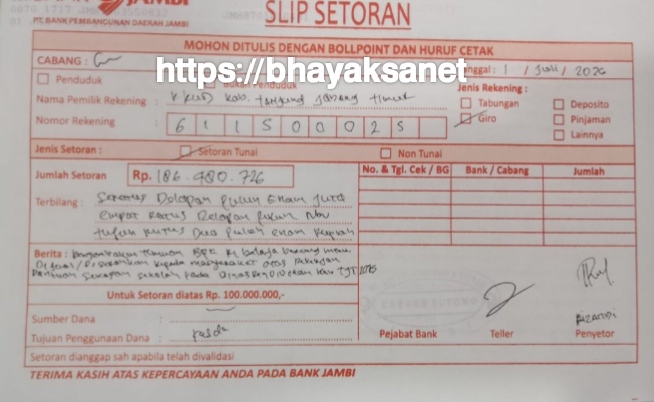
Addressing the mandatory rectifications required by BPK RI, the Head of the Primary Education Division at the Tanjab Timur Education Agency, Mario, confirmed that the financial overpayment has been administratively settled. An authorized representative of the vendor, identified by the initial R, complied with the civil directives by refunding the entire overpayment of $11,500 (Rp186,480,726) back into the Regional Cash Account (Kasda) via Bank 9 Jambi, backed by official bank deposit slips.
Under civil law and Administrative Government Law No. 30 of 2014, the financial damages are formally considered resolved since the refund was executed within the mandatory 60-day statutory window post-audit. Nevertheless, anti-corruption activists and local journalists continue to press Law Enforcement Agencies (APH) to investigate alleged internal gross negligence and potential structural flaws within the local electronic marketplace (e-Catalog) system.
This legal distinction is critical. Under Article 4 of the Law on the Eradication of Criminal Acts of Corruption (UU Tipikor), the administrative return of stolen or overpaid state funds does not erase criminal liability. If law enforcement uncovers credible evidence of criminal intent (mens rea), abuse of structural authority, active bribery, or the falsification of verification documents during the initial planning phases, the criminal corruption case can proceed independently of the refund. According to Supreme Court Regulation (PERMA) No. 1 of 2020, voluntary financial restitution serves only as a mitigating factor to reduce a defendant’s final prison sentence at trial, not as a ground for dismissal.
Reporter: Harvery.
Editor: bhayaksa.net Team