
Oplus_131072
MEDAN, bhayaksa.net – The Batak tribe, indigenous to North Sumatra, remains deeply bound to their unbreakable ancestral customary laws. Among the various cycles of life, the traditional funeral rite stands as the most paramount, foundational, and mandatory ritual for every family. Indeed, a profound social axiom dictates that no matter how impoverished a family may be, this sacred tradition must strictly be carried out.
A direct field observation reveals how these kinship values operate with absolute authority within the community. Conducting a traditional funeral feast is far from a mere formality; it is a vital preservation of family dignity and the ultimate homage to an elder transitioning to the ancestral realm.
Echoes of Gondang and Wailing: A Sacred Atmosphere
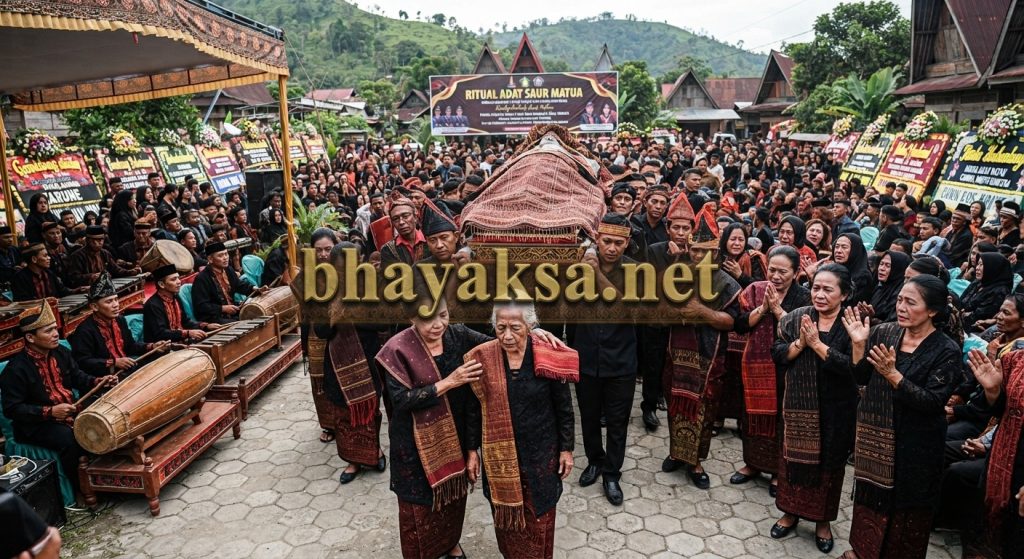
The ambiance at the ritual site stirs the soul. Since the early hours, the dynamic thuds of the Gondang Sabangunan (the traditional Batak musical ensemble) echo through the air, chanting the melodies of Gondang Topeng and Gondang Simonang-monang to honor the spirit’s final journey. This majestic music blends profoundly with the andung-andung (traditional mournful wailing) sung by the female clan members, piercing the hearts of those present.
In the courtyard, the children and grandchildren of the deceased kneel solemnly around the casket. Tears of deep sorrow flow uncontrollably as the Hula-hula line walks gracefully into the pavilion, bearing sacred hand-woven fabrics (Ulos) with eyes full of spiritual reassurance. Despite the heavy grief, the presence of hundreds of relatives filling the venue provides immense fortitude to the grieving family.
Specific Details of the Mandatory Ulos Garments
Within these funerary rites, the presentation of Ulos follows a rigorous customary protocol that must never be altered. Field observations show three main types of Ulos that must be presented, each corresponding to a specific role within the Dalihan Na Tolu kinship structure:
- Ulos Saput (Typically utilizing Ulos Ragi Hotang or Ulos Pinunsaan)
- Giver: The Hula-hula (the family of the deceased’s wife) or Tulang (the maternal uncle of the deceased).
- Function: This fabric is wrapped directly over the deceased as a customary shroud. It symbolizes the warm, final blessing from the source of life (Hula-hula), guiding the spirit into eternity.
- Ulos Tujung (Typically utilizing Ulos Mangiring, Ulos Sibolang, or dark-toned Ulos Ragi Hidup)
- Giver: The Hula-hula clan.
- Function: Draped over the head of the surviving spouse (the widow or widower) as a profound symbol of mourning (tujung). This cloth is uncovered just before the burial through a special ritual called Mansuai Tujung, signaling the end of the immediate physical mourning period and releasing them from worldly marital bonds.
- Ulos Herbang (Ulos Ragi Hidup or Ulos Sadum)
- Giver: The Bona ni Ari (the primordial maternal clan) or close external relatives.
- Function: Handed down to the children of the deceased as Ulos Ampang (the shoulder cloth of honor) to bestow strength, resilience, and a spiritual guarantee that the surviving lineage will be blessed with longevity and prosperity.
Voices of the Elders: “Customary Rite is a Debt, Mutual Aid is the Answer”
In the midst of the ceremony on Tuesday, September 15, 2026, journalists from this media outlet interviewed Opung Raja Parlindungan Hutapea (68), a prominent customary elder (raja adat) in Medan. He explained the deep philosophy behind why this ritual remains absolutely binding, regardless of economic status.
“For us, the Batak people, a funeral rite is a customary ‘debt’ that must be paid in this world. No matter how poor the grieving family is, this ceremony must stand tall. Why? Because when someone passes away without the customary rites, the dignity of the deceased in the afterlife is tarnished, and their descendants will bear a lifetime of shame for supposedly neglecting their parents,” Opung Parlindungan stated authoritatively on Tuesday, September 15, 2026.
He further emphasized that material poverty never causes the collapse of custom, thanks to the robust social foundation of the Batak society.
“Outsiders often mistake our customs for a consumerist burden. It is not. This is the beauty of ‘Dalihan Na Tolu’. If the suhut (the immediate grieving family) does not have a single penny, then the ‘Dongan Tubu’ (marga kinsmen) and the ‘Boru’ (the son-in-law’s clan) will pitch in to raise the funds. The ‘Hula-hula’ arrives bringing ulos and rice. Everything moves automatically without being asked. Therefore, whether rich or poor, the funeral rite proceeds smoothly because it is carried by the community, not the individual,” he concluded firmly.
Mutual Aid in the Face of Poverty
This social defense mechanism ensures that no deceased member is ever left behind due to financial constraints. Through customary deliberations (tonggo raja or riaria), all expenses are transparently itemized and shared equally among the kinsmen of the same surname (marga).
For the Batak people, allowing a relative to be buried without custom is the ultimate disgrace for the entire clan. Thus, clan solidarity ensures that under any level of poverty, the traditional funeral rite and the sacred Ulos rituals will always be executed with absolute honor.
These traditional funeral rites prove that for the Batak tribe in Medan and its surrounding regions, custom is not merely an expensive set of ceremonies, but an unbreakable social lifeline that material poverty can never destroy.
Pewarta: Haposan Sinabutar
Editor: bhayaksa.net Team