
Oplus_131072
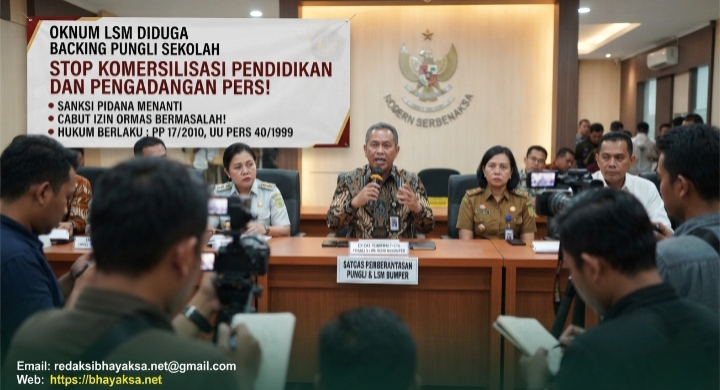
JAKARTA, bhayaksa.net—- Commercialization practices within government-funded educational institutions have sparked severe public backlash following the recent student admission period (PPDB) last July. A new modus operandi has emerged involving rogue local Non-Governmental Organizations (NGOs) that allegedly position themselves as shields or shock absorbers for corrupt school administrations. Instead of performing their public oversight function to report violations, these rogue entities have actively approached journalists and allied advocacy groups, pressuring them to withhold publication, refrain from reporting findings, and cancel planned public protests regarding suspected illegal levies on school uniforms and student workbooks (LKS).
This situational containment tactic is reportedly widespread to cover up institutional violations regarding mandatory apparel purchases. Numerous parents of newly admitted students confessed they felt forced to purchase overpriced uniform and workbook packages ranging from hundreds of thousands to millions of rupiah just to ensure their children could attend class without administrative hurdles. When local journalists and regional activists uncovered this pattern of maladministration, the rogue NGOs acting as “school security partners” immediately moved to conduct persuasive tactics and subtle intimidation to settle the matter “under the table” away from public scrutiny.
Official Statements from Jakarta
Responding to reports of regional press members and local organizations being restricted from exercising their right to protest, national civil society organization leaders based in Jakarta directly addressed the matter during an exclusive interview panel on September 25, 2026. Below is the official transcript of expert legal assessments and organizational stances:
1. National Civil Society Leader
- Name: Muhammad Al-Fatih (Central Chairperson of the Alliance for Civil Society Transparency – ATMS Pusat, Jakarta)
“We strongly condemn these actions from the central headquarters! This is a prostitution of the profession and a direct betrayal of public oversight values. NGOs are established to monitor the government and defend citizens’ rights, not to serve as security agencies protecting extortions run by school principals or committees. As of September 25, 2026, the central leadership officially instructs all regional networks: if any of our members or partner organizations are proven to accept bribes or act as bumpers for uniform extortion during the past PPDB, we will recommend the Ministry of Home Affairs and the Ministry of Law and Human Rights to revoke their legal status under Law No. 17 of 2013 on Mass Organizations. We also urge regional journalists to confidently report any restriction on press freedom to the police.”
2. Jakarta Legal Analyst
- Name: Dr. Hendra Wijaya, S.H., M.H. (Criminal Law Expert & Executive Director of Jakarta Legal Watch)
“This constitutes an obstruction of justice through sophisticated situational conditioning. Under the criminal code, if any covert financial agreement or fund flows are proven from the school to the rogue NGO to secure the case, it qualifies as criminal conspiracy. Furthermore, pressuring journalists to halt publication directly violates Article 18 of the Press Law, carrying a 2-year prison sentence. Restricting other organizations from protesting directly violates Article 18 of Law No. 9 of 1998 on Freedom of Expression.”
3. Educational Policy Expert
- Name: Prof. Dr. Sartika Mansur (Professor of Educational Policy, University of Jakarta)
“The root cause is the capitalization of public education spaces. Public schools are fully funded by the government through BOS grants. Article 181 of Government Regulation No. 17 of 2010 explicitly forbids teachers or principals from selling uniforms and workbooks. When principals fear dismissal under the Civil Servant Discipline Regulation (PP No. 94/2021), they seek external protection. Opportunistic rogue NGOs capitalize on this institutional fear.”
4. Educational & Social Psychologist
- Name: Dra. Rininta Utama, M.Psi. (Social Psychologist & Child Development Consultant, Jakarta)
“For new parents, what should be a proud milestone turns into severe financial distress. They experience severe psychological pressure, feeling that if they refuse to pay for these expensive uniforms, their children will face social isolation or rejection. For the children, entering an environment built on corrupted transparency inadvertently conditions them to accept institutional dishonesty and fear the truth.”
5. Public Policy & Mass Organization Observer
- Name: Irwan Ramadhan, M.Si. (Director of the Study for Public Policy and Mass Organizations, Jakarta)
“The chain must be severed from the top down, not from the bottom up. Do not engage in mediation at the school level because the environment there is already controlled by the rogue entity. Victims and press representatives must bypass local channels and report directly to the Central Saber Pungli Task Force, the Ministry’s Inspectorate General, or the Indonesian Ombudsman.”
LEGAL FRAMEWORK AND APPLICABLE SANCTIONS
Commercializing uniform and workbook sales in state-funded schools, combined with external attempts to safeguard such actions by silencing protests, carries heavy statutory penalties under Indonesian law:
- Sanctions for Obstructing the Press (Law No. 40 of 1999 on the Press): Article 4, Paragraph (3) guarantees the freedom of the national press to seek and disseminate information. Under Article 18, Paragraph (1), any person who intentionally inhibits or obstructs these provisions faces a maximum of 2 years imprisonment or a fine of up to IDR 500,000,000 (Five Hundred Million Rupiah).
- Sanctions for Obstructing the Right to Protest (Law No. 9 of 1998): Article 18, Paragraph (1) dictates that anyone who uses violence or threats of violence to block citizens from expressing public opinions faces up to 1 year imprisonment.
- Prohibition of Uniform & Workbook Sales in Public Schools (Government Regulation No. 17 of 2010): Article 181 strictly prohibits educators and school staff from selling textbooks, workbooks, uniforms, or textile materials within educational institutions. Violations by civil servant principals carry severe disciplinary sanctions, including demotion or dishonorable dismissal under Government Regulation No. 94 of 2021 on Civil Servant Discipline.
- Revocation of Legal Status for Mass Organizations (Law No. 17 of 2013 on Mass Organizations): If an NGO is proven to abuse its social control function to protect illegal activities for financial gain, the Ministry of Home Affairs or the Ministry of Law and Human Rights holds the absolute authority to issue administrative sanctions ranging from temporary suspension of activities to the revocation of legal entity status (forced dissolution).
Press members and regional advocacy alliances facing oversight restrictions are strongly advised to bypass localized mediations and submit all evidentiary documentation directly to official law enforcement task forces to safeguard public education from extortion schemes.
Reporter: Timothy
Editor: bhayaksa.net Team